
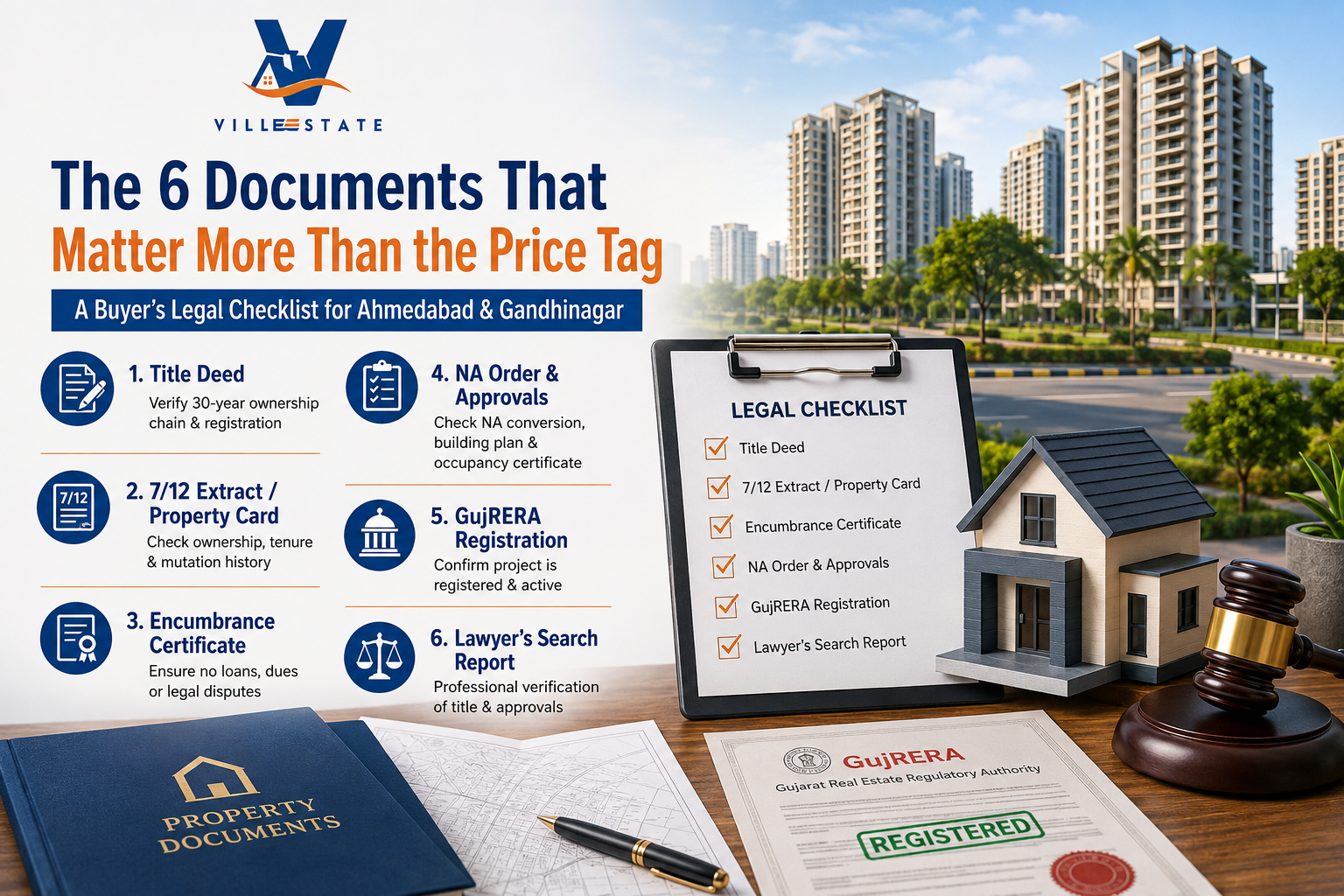
Every property conversation in Ahmedabad and Gandhinagar starts with the same three questions: location, price, and possession date. Almost nobody starts with the fourth question that actually protects their money — is this property legally clean?
That's a mistake. A flat in SG Highway or a plot near GIFT City can look perfect on paper and still come with a title dispute, an unregistered mother deed, or a lapsed RERA registration hiding underneath. The good news is that Gujarat has quietly become one of the easier states in India to verify a property in, thanks to digitized land records and an active regulator. Most buyers just don't know where to look.
Here's the checklist we walk our own clients through before any booking amount changes hands.
1. The Title Deed (Mool Dastavej) — and its 30-year chain
The title deed is the single document that proves the seller actually owns what they're selling. But checking today's deed in isolation isn't enough. Every sale deed, gift deed, or partition deed in Gujarat traces back to an original "mother deed," and if that root document is weak, everything built on top of it is too.
What to actually check:
- Trace ownership back at least 30 years, not just to the seller's immediate purchase
- Confirm the deed was registered with the Sub-Registrar — an unregistered deed for property valued over ₹100 has effectively no legal standing in Gujarat, no matter how official it looks
- Cross-check the registration number through the Garvi property search portal; if the number doesn't match or doesn't exist, that's a walk-away red flag
Banks apply the same 30-year rule before sanctioning a home loan, so if your bank's legal team flags a gap in the chain, don't try to work around it — treat it as the same warning they're giving you.
2. 7/12 Extract or Property Card — and knowing which one applies
This is where a lot of buyers get confused, because Gujarat runs two separate record systems depending on where the land sits.
- Rural or village land (farmland, land outside municipal survey limits) is recorded in the 7/12 extract and 8A, available under "View Land Record - Rural" on the AnyROR portal
- Urban land inside Ahmedabad, Gandhinagar, or other municipal survey areas doesn't have a 7/12 at all — it has a Property Card, found under "View Land Record - Urban"
Asking a seller for a 7/12 on a flat inside city limits, or a Property Card for a farmland plot, will get you nowhere. Know which system your property falls under before you start searching.
Three things to actually read off the record, not just glance at:
- The current owner's name — does it match the seller's name on the sale deed?
- The tenure type — "new tenure" (navi sharat) land in Gujarat cannot be sold without prior Collector permission, which is easy to miss and expensive to discover late
- The mutation history (VF-6 entries) — this shows whether ownership transfers were actually recorded, not just verbally agreed
The free online view is fine for your own reference, but banks and the registrar's office will want the ₹15 Digitally Signed Record of Rights, issued through the government's iORA portal — budget a few extra days for that if you're on a tight registration timeline.
3. Encumbrance Certificate — is the property actually free to sell?
An Encumbrance Certificate (EC) confirms the property carries no outstanding mortgage, loan, court case, or competing claim. Request it for a 13 to 30 year period from the Sub-Registrar's office, and read it carefully rather than just confirming it exists — a "nil encumbrance" certificate is what you want to see; anything listing an active charge needs a lawyer's explanation before you go further.
One thing worth remembering: a property under active court dispute can still be advertised and shown to buyers. Neither the title deed nor a quick glance at the EC will flag this on its own — pairing a full-period EC with your lawyer's search report is what actually catches it.
4. NA Order and Municipal/TP Approvals
If the land was originally agricultural and is now being sold for residential or commercial use, it needs a Non-Agricultural (NA) conversion order. Without it, construction on that land is technically unauthorized, regardless of what's already built.
Alongside the NA order, ask for:
- Sanctioned building plan from AUDA, AMC, GMADA, or the relevant local authority
- Town Planning (TP) scheme approval, where applicable
- Occupancy certificate, if the building is complete
These approvals are what your bank's legal team and, later, any future buyer will ask for. Skipping this step now just moves the problem to whoever tries to resell or refinance the property later — which might be you.
5. GujRERA Registration — and what it does and doesn't tell you
Since 2016, any project of a qualifying size in Gujarat must be registered with the Gujarat Real Estate Regulatory Authority before it can be advertised or sold. Checking this takes five minutes and can save months of dispute later.
How to check it yourself:
- Go to the official portal: gujrera.gujarat.gov.in (verify the URL carefully — only the government site is authoritative)
- Open the "Registration" tab and select "Projects"
- Search by the RERA registration number if you have it, or by exact project/developer name
- Confirm the status is active — a "lapsed" status means the registration expired without the project being completed, which should immediately raise questions
Worth being clear-eyed about: GujRERA registration confirms what the developer has declared — timelines, approved plans, disclosures. It doesn't independently confirm how reliably the project will actually be delivered. Pair the RERA check with the developer's track record on past projects, not as a replacement for it.
6. A Fresh Search Report from a Property Lawyer
Every document above can be pulled individually, but the step that ties them together is a lawyer's search report — a professional's read of the title chain, encumbrance history, and approval trail as a whole, not as separate checkboxes. This is especially worth the fee for:
- NRI buyers who can't easily visit government offices to pull records in person
- Resale properties with multiple past owners
- Any land that started as agricultural and has since changed hands or use
A few hundred rupees and a few days for a proper search report is a small price against the cost of untangling a title dispute after you've already registered the property in your name.
The bottom line
None of this is meant to make buying property in Ahmedabad or Gandhinagar sound intimidating — the region's digitized records and active regulator actually make verification more accessible here than in most Indian markets. The mistake is treating "the price is good and the location works" as the whole decision. The documents above take a few days and a modest fee to verify properly. A bad title takes years and lakhs of rupees to unwind.
At VilleState, every listing on our platform is screened for exactly these fundamentals before it reaches a buyer's shortlist — because the right price on a legally clean property is worth far more than a lower price on one you can't be sure of.
Looking to buy in Ahmedabad or Gandhinagar? Browse verified listings on VilleState or get in touch with our team before you sign anything.